Motorhomes, vans and trailers: when the vignette rules change
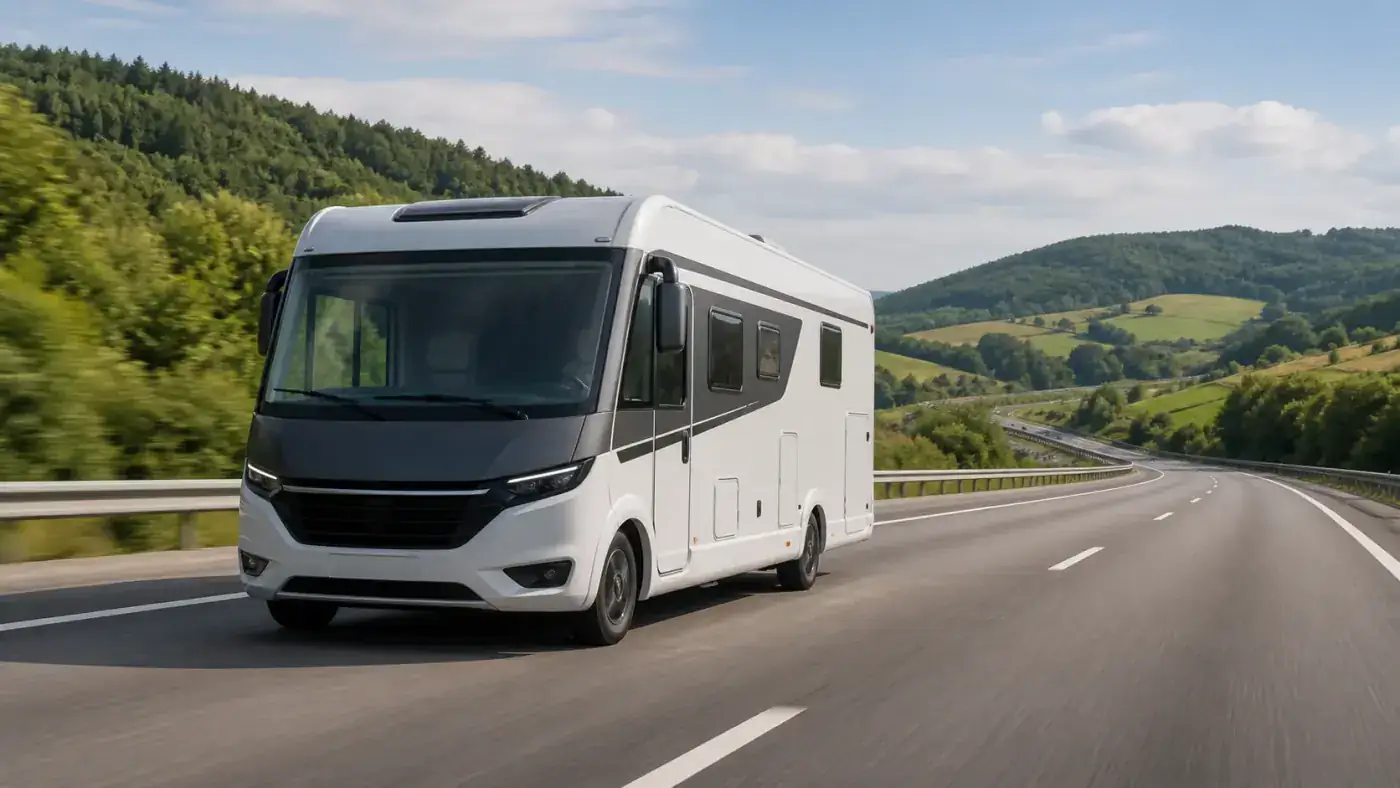
Hitch a caravan to your car and Austria charges you nothing extra. Drive the same combination into Switzerland and you owe a second vignette for the trailer. One tow bar, two national logics, and nobody tells you at the border. Campers, tall vans and trailers are where the tidy one-vignette-per-country picture falls apart, so here is what actually changes and where.
On this page
The number that decides everything is 3.5 tonnes
Every vignette country draws its first line at 3.5 tonnes of maximum permissible weight, and that single figure decides whether you buy a vignette at all or enter a distance-based toll system built for lorries. Austria's official guidance puts it plainly: the vignette applies to vehicles with a technically permissible maximum laden mass of up to 3.5 tonnes. Below the line you are a car, with all the convenience that implies. Above it you are freight, as far as the tolling software is concerned.
The figure that counts is the plated maximum, not what your camper weighs today with an empty water tank. Look at your registration document, not the bathroom scales. And do not confuse it with the second question, which catches far more people out: what happens when something is attached to the back.
What a trailer changes, country by country
A trailer changes the bill in three different ways depending on which border you are crossing, and there is no pattern to memorise. Austria is the generous one. ASFINAG's guidance states that trailers, caravans and motorcycle sidecars need no additional vignette, that only the towing vehicle counts for the toll obligation, and that the weight of the trailer does not matter. One car vignette covers the lot.
Switzerland does the exact opposite. The Swiss Federal Office for Customs and Border Security (BAZG) confirms that a trailer needs its own vignette unless it is subject to the heavy vehicle charge, with an exemption only for trailers behind motorbikes. That is one of several quirks in riders' favour, collected in our guide to vignette rules for motorcycles. The 2026 Swiss vignette costs CHF 40 and runs from 1 December 2025 to 31 January 2027, so a car plus caravan is CHF 80 for the pair. Budget for it. People genuinely arrive at the Basel approach roads expecting one.
Slovakia sits in the middle with a threshold rule. If the towing vehicle and trailer together exceed 3.5 tonnes, the trailer needs its own vignette in category O1 or O2 alongside the one on the car; under that figure the car vignette is enough. Czechia does not add up the weights at all, so one vignette covers a car under 3.5 tonnes whatever it is pulling. Hungary ties the trailer to the towing vehicle's own class: according to the National Toll Payment Services information for recreational vehicles, a vehicle needing a D1 vignette tows without a separate trailer vignette, while a vehicle in D2 must buy a category U vignette for the trailer.
Trailer and heavy-vehicle rules at a glance
The table below sets the trailer rule and the over-3.5-tonne rule side by side for all eight vignette countries, which is the comparison you actually need when planning a route. Sources are named per row and were checked in September 2026. Prices move every year, so the country pages carry the current tariffs and durations.
| Country | Car under 3.5 t towing a trailer | Above 3.5 t |
|---|---|---|
| Austria | No extra vignette; only the towing vehicle counts and the trailer weight is irrelevant (ASFINAG) | GO toll, per kilometre via a GO-Box |
| Switzerland | Trailer needs its own vignette, CHF 40, unless subject to the heavy vehicle charge (BAZG) | Flat-rate heavy vehicle charge (PSVA) |
| Czechia | One vignette; weights of car and trailer are not added together | Electronic toll system registration |
| Slovakia | Second vignette for the trailer (O1/O2) once the combination passes 3.5 t | MYTO distance toll |
| Slovenia | No trailer vignette; the towing vehicle's toll class 2A or 2B decides the price (DARS) | DarsGo on-board unit, in force since 1 April 2018 |
| Hungary | D1 tows free; D2 needs a category U trailer vignette (National Toll Payment Services) | Category depends on the registration entries |
| Romania | Category A covers cars, vans and campers up to 3.5 t | Rovinieta continues, in weight categories above 3.5 t |
| Bulgaria | E-vignette for the vehicle up to 3.5 t | Distance-based toll for vehicles over 3.5 t |
Sources: ASFINAG help centre, BAZG vignette FAQ, oesterreich.gv.at vignette page, DARS e-vinjeta toll classes, Slovenian DarsGo pages, Hungarian National Toll Payment Services recreational-vehicle guidance, Czech and Slovak operator portals. Checked September 2026.
When your motorhome crosses 3.5 tonnes
A motorhome over 3.5 tonnes normally leaves the vignette system entirely and joins the toll built for trucks, which is a different purchase with different admin. In Austria that is the GO toll: a GO-Box on the windscreen, charged per kilometre according to axles, emission class and time of day. There is a detail worth knowing before you drive off with the box, because Austrian practice gives you 28 days to submit the registration or COP certificate proving your emission class, and a missing document means being billed at the worst rate.
Slovenia moves you to the DarsGo unit, Czechia and Slovakia to their electronic toll systems, and Bulgaria to its distance-based toll. Romania is the pleasant exception: its rovinieta simply continues into weight categories above 3.5 tonnes, so the purchase stays a vignette rather than becoming a fleet-management exercise.
The transitional rule that saves some heavy campers. Austria carries a provision for vehicles whose technically permissible weight is over 3.5 tonnes but which had a maximum permissible weight of up to 3.5 tonnes recorded before 1 December 2023. Those vehicles stay in the vignette system until 31 January 2029. If your camper was plated that way, check the registration document before you order a GO-Box you do not need.
Slovenia measures your roof, not just your weight
Slovenia is the one country where a tall vehicle under 3.5 tonnes can cost more than a car, because DARS splits light vehicles by height above the front axle. Toll class 2A covers vehicles up to 3,500 kg measuring 1.3 metres or less at that point. Class 2B covers the same weight bracket above 1.3 metres, which is where most high-roof vans land, and it is the dearer class.
There is a carve-out, and it is specific. DARS classifies listed models registered as caravan vehicles in 2A regardless of height, provided the vehicle is marked SA on the registration certificate or an equivalent document from a competent authority. Without that marking, the same van is 2B. So a converted Ducato with the paperwork done is charged as a car, and a converted Ducato without it is not. Check the DARS measured-vehicle list for your model rather than guessing from the shape of the roof, and see the Slovenia vignette page for the current class prices.
Read the registration document before you book
Your vehicle registration certificate answers every classification question on this page, which is why it should be open in front of you when you order. Field F.1 or F.2 gives the maximum permissible weight that decides vignette or heavy toll. Field J gives the vehicle category that Hungary reads when sorting recreational vehicles into D1 or D2. The SA body code is what keeps a tall camper in Slovenia's cheaper class.
Two minutes with that document is worth more than any amount of guessing at a petrol station. It also protects you from the trap that costs the most money of all: buying the right vignette for the wrong category, which several operators treat as no valid entitlement rather than a partial payment. If you want the country-by-country map of where vignettes apply at all, our guide to which European countries need a vignette covers the whole route, and vignettes versus toll roads explains the barrier tolls that sit on top in France and Italy.
Ordering for a camper or a combination
Ordering for a camper or a car-and-caravan means one decision per country, and Vignettera lets you make them in a single checkout instead of five national portals in five languages. Enter the plate exactly as it reads on the vehicle, pick the countries and dates, and you see the official state fee and our service fee itemised before you pay. Where a second vignette is needed for the trailer, as in Switzerland, add it in the same order rather than discovering it at the approach road. Order your official digital vignette here.
You can equally buy each one direct from the national operator at the state fee alone, and for a single country that is often the simplest path. Drivers use us when the route crosses four or five borders and the classification rules differ at each. If the camper is hired rather than owned, the plate rules change again, and our guide to vignettes for a rental car covers that case.
Motorhome and trailer vignette FAQ
Does a caravan or trailer need its own vignette?
It depends on the country, and the two extremes sit next to each other. ASFINAG says an Austrian trailer or caravan needs no vignette of its own, because only the towing vehicle counts and the trailer's weight is irrelevant. Switzerland's BAZG takes the opposite line: a trailer needs its own vignette unless it falls under the heavy vehicle charge, so a car and caravan means two vignettes at CHF 40 each. Slovakia adds a trailer vignette once the combination passes 3.5 tonnes, and Hungary adds a category U trailer vignette only when the towing vehicle itself is in D2.
What happens when a motorhome weighs more than 3.5 tonnes?
Above 3.5 tonnes maximum permissible weight, a motorhome usually leaves the vignette system and joins a distance-based toll. Austria switches you to the GO toll with a GO-Box on the windscreen, billed per kilometre by axles, emission class and time of day. Slovenia uses the DarsGo unit, in place for vehicles over 3.5 tonnes since 1 April 2018, and Czechia and Slovakia move you to their electronic toll systems. Romania is the exception that keeps you in the vignette: its rovinieta runs through weight categories well above 3.5 tonnes.
Is a high-roof van charged more than an ordinary car?
In Slovenia it can be, because DARS splits vehicles up to 3.5 tonnes by height above the front axle. Toll class 2A covers vehicles up to 1.3 metres at that point, and anything higher falls into 2B, which is the more expensive class. Motorhomes get an exemption: a vehicle on the DARS measured-vehicle list and registered as a caravan vehicle, marked SA on the registration certificate, stays in 2A whatever its height. A tall van without that marking pays the 2B rate.
Which document do I need before I buy a vignette for a camper?
The vehicle registration certificate, because every classification question is answered on it. Field F.1 or F.2 carries the maximum permissible weight that decides if you are in the vignette system at all. Field J gives the vehicle category, which Hungary uses to sort recreational vehicles into D1 or D2. The SA body-code marking is what keeps a tall camper in Slovenia's cheaper 2A class. Have it open when you order, not in the glovebox at the border.